Why Habitat 67 matters.
Habitat 67 in Montréal is more than an architectural landmark, it's a manifesto in concrete, a visionary dream that redefined how cities could look, feel, and breathe.
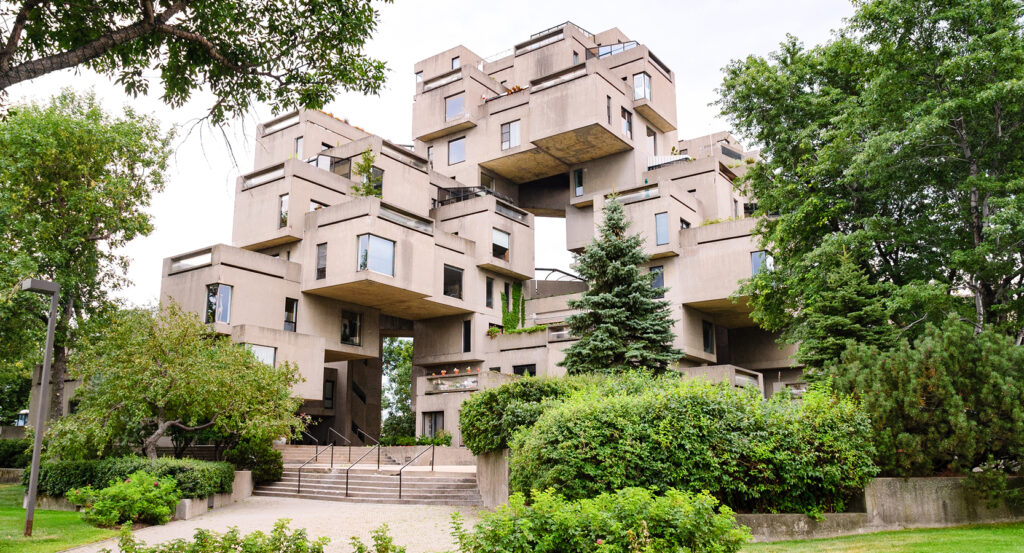
Perched along the Saint Lawrence River, its striking geometry is unmistakable: 354 prefabricated concrete cubes stacked in random formation, cascading toward the water like a sculptural skyline frozen mid-motion. Designed by architect Moshe Safdie for Expo 67's famed World's Fair, the complex was intended as a bold experiment in urban living, merging the benefits of suburban space with the density of city life. More than five decades later, it still feels futuristic, an icon that defies time. Every unit in Habitat 67 has its own terrace, its own light, its own rhythm, with greenery spilling over balconies like nature reclaiming the structure. As the sun moves across the sky, the cubes cast angular shadows that shift with the river's reflection, creating a living mosaic of light and architecture. From the water's edge, the building looks like a dream half-built, half-remembered, the perfect example of Montréal's experimental spirit.
What defines Habitat 67.
The story behind Habitat 67 is as revolutionary as the building itself.
When Moshe Safdie conceived the design as his master's thesis at McGill University, few believed such a structure could be built, let alone become a global icon. Yet when Expo 67 selected his concept as part of Canada's national pavilion, it marked a turning point in architectural history. Safdie, only 29 at the time, envisioned a modular housing system that could be replicated worldwide, using prefabrication to make high-quality urban living affordable. Each of the building's 158 residences was constructed from identical concrete modules, craned into position and interlocked like building blocks. Despite its success, the dream of large-scale replication never materialized due to cost, Habitat 67 became a one-of-a-kind experiment rather than a new model for living. Over time, its myth grew. Architects and designers from around the world came to study its daring form and human-centered vision. The building's ownership shifted from government housing to private residences, with many original residents still calling it home today. Its terrace gardens, panoramic river views, and tranquil design make it one of the most coveted addresses in Montréal. Few realize that Habitat 67 is also a symbol of the city's optimism during the 1960s, a moment when Montréal dared to believe it could shape the future.
How Habitat 67 fits.
To experience Habitat 67 is to step inside a living sculpture, one that continues to inspire awe with every angle and shadow.
Start the visit by approaching from Old Montréal, crossing the Pont de la Concorde toward Cité du Havre, where the structure rises dramatically against the skyline. The best vantage points are from the riverside promenade or by taking a river cruise, where you can admire the blend of light and form from the water. If you're lucky enough to join a guided tour, offered by the building's residents, you'll gain rare access to its interiors and rooftop terraces, which reveal how the complex was designed to weave privacy and community together. From certain viewpoints, the cubes seem to float above the river, a visual metaphor for Montréal's blend of imagination and realism. Nearby, you can stroll along the Habitat 67 Skatepark or continue toward Parc de la Cité-du-Havre for panoramic views of downtown. Visit during golden hour, when the building glows honey-colored against the skyline, and you'll understand why photographers and architects alike describe it as Montréal's architectural heartbeat. Habitat 67 isn't just a landmark, it's a conversation between form and function, humanity and innovation, the past and the possible. It stands as proof that a single idea, born from vision and courage, can reshape how we see the world.
Where your story begins.
Foresyte Travel reveals places that feel extraordinary long before you arrive.
Enjoy editorial crafted for luxury travelers.
Foresyte may earn a commission when you book.