Why you should experience Queen Elizabeth Quarry Gardens in Vancouver, British Columbia.
Queen Elizabeth Quarry Gardens is Vancouver's most enchanting secret, a sunken sanctuary carved from stone and reborn into paradise.
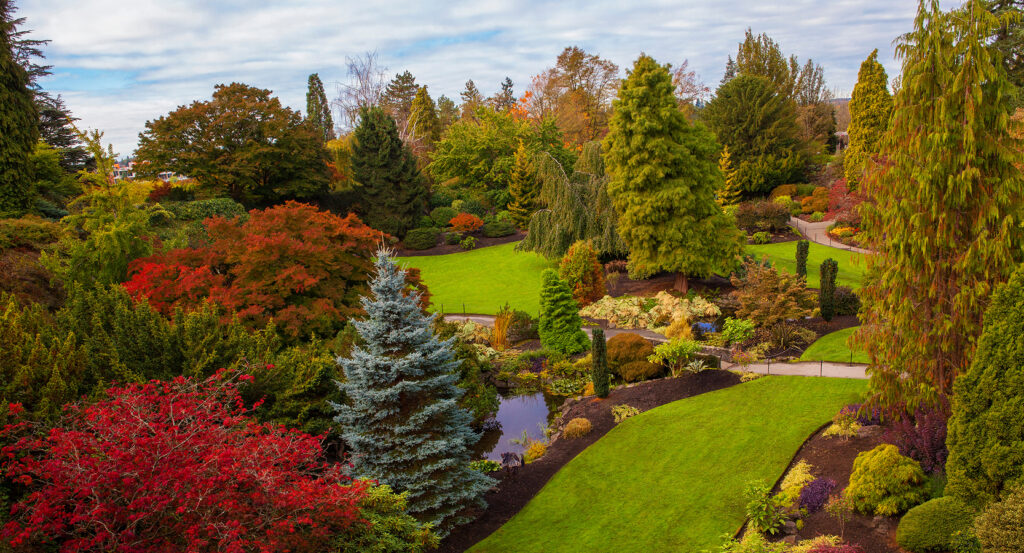
What was once a rugged basalt pit that supplied the city's earliest roads now feels like something lifted from a dream: a terraced oasis of waterfalls, bridges, and blooming color cupped within volcanic cliffs. As you descend the winding paths, the air grows cooler, the city noise fades, and the world narrows to the soft rustle of leaves and the distant murmur of water. Every curve reveals a painter's palette, Japanese maples, rhododendrons, azaleas, and tulips arranged in effortless harmony. The stone walls rise dramatically around you, streaked with moss and shadow, giving the impression of walking through a natural amphitheater sculpted by time and patience. In spring, the garden bursts alive in a crescendo of pinks and golds; by autumn, it smolders in deep reds and copper. This is where Queen Elizabeth Park's beauty turns intimate, not grand like the fountains above, but quiet and eternal, a triumph of human design and nature's resilience intertwined.
What you should know about Queen Elizabeth Quarry Gardens.
Queen Elizabeth Quarry Gardens is more than just the heart of Queen Elizabeth Park, it's the reason the park exists at all.
In the early 20th century, this site was a working quarry, its basalt used to pave Vancouver's streets. When the quarry was abandoned in the 1910s, the crater lay forgotten for decades, a scar in the earth overrun with weeds. It wasn't until the 1930s, under the guidance of park superintendent W.S. Rawlings, that the vision for transformation began. But the true artistry came in 1961, when landscape designers Bill Livingstone and Wally Earnest reimagined the pit as a living garden. They recognized that the quarry's sunken shape created a unique microclimate, protected from winds and rich with natural drainage, perfect for cultivating delicate plants rarely seen outdoors in Vancouver. Over several years, the designers hand-sculpted terraces, installed cascading ponds fed by recycled water systems, and carefully layered vegetation to mimic a mountain valley in miniature. Many of the boulders you see today were placed by crane, arranged for both balance and visual rhythm. The paths and bridges were designed to encourage movement and stillness in equal measure, every turn offering a framed view, every ledge a pause for reflection. The garden's water features were engineered with an early form of ecological sensitivity: the ponds collect and filter rainwater through natural stone channels, keeping the ecosystem self-sustaining. The result is a masterpiece of mid-century landscape architecture, a study in contrasts between the permanence of rock and the fleeting life of bloom. Few realize that Queen Elizabeth Quarry Gardens also inspired the park's later expansions, including the Bloedel Conservatory and Arboretum Plaza above, making it not just a garden, but the seed from which all of Queen Elizabeth Park grew.
How to fold Queen Elizabeth Quarry Gardens into your trip.
To experience Queen Elizabeth Quarry Gardens properly, you have to slow down, it's a place that reveals itself in silence and motion.
Enter from the 33rd Avenue west entrance, following the gently sloping trail that winds through flowering shrubs and over arched bridges. Plan to spend 45 minutes exploring, longer if you're visiting in spring or autumn, when the light turns the quarry walls into living canvases. Start from the upper terrace and look down into the basin, the way the garden curves inward gives it a sense of infinity. As you descend, listen to the change in sound: birdsong grows sharper, water more defined. Follow the main loop trail counterclockwise; you'll pass small alcoves where benches hide among ferns, and cross bridges that seem to hover over mirror-still ponds. The best time to visit is midmorning, when sunlight filters through the trees and reflects off the water's surface, creating a glow that feels almost cinematic. For photographers, the western edge near the waterfall offers the most striking vantage point, capturing both the height of the cliffs and the depth of the garden floor. After you climb back toward the summit, pause at the upper lookout beside the Bloedel Conservatory, from here, you can see how the garden's lush basin contrasts with the manicured parkland above. Pair your visit with a walk to the Dancing Waters Fountain or lunch at Seasons in the Park, both within a short stroll. However you approach it, Queen Elizabeth Quarry Gardens is where Vancouver's natural history and human artistry converge, a place that began as a wound in the earth and ended as its most beautiful scar.
Where your story begins.
Foresyte Travel reveals places that feel extraordinary long before you arrive.
Experience premium editorial crafted for luxury travelers.