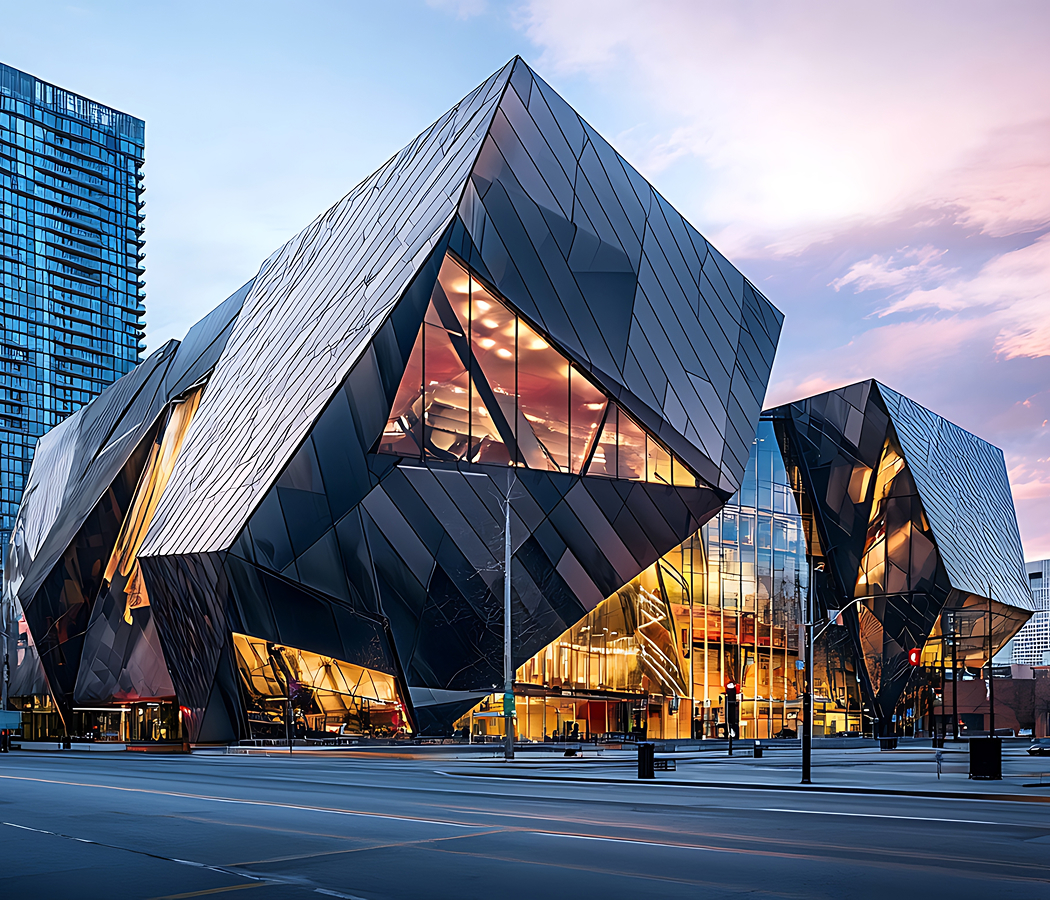
Why you should experience OMNIMAX Theatre at Science World in Vancouver, British Columbia.
The OMNIMAX Theatre at Science World in Vancouver is not just a cinema, it's an immersion chamber, a cathedral of motion and sound where storytelling transcends the screen.
Housed within the shimmering geodesic dome that crowns the skyline over False Creek, the theatre transforms ordinary viewing into a physical experience. You don't simply watch, you feel the horizon tilt beneath you, the ocean swell around you, the wind sweep through distant canyons. The screen itself wraps a full 27 meters in diameter, curving overhead in a seamless half-sphere that engulfs your entire field of vision. Each film becomes a kind of journey, from glacial mountain peaks to coral reefs, from Mars to microscopic cells, projected with the precision of custom fisheye lenses and sound systems calibrated to make air vibrate like water. The architecture itself is part of the thrill: steep, stadium-style seating ascends toward the dome's apex, giving every visitor a sense of floating in space. Step into the dark, and the chatter hushes to a shared inhale, then light bursts to life, and you're inside a story too vast for flat edges.
What you should know about OMNIMAX Theatre at Science World.
The OMNIMAX is among the largest and most technically sophisticated dome theatres in the world, and the only one of its scale in Western Canada.
Installed during the transformation of the Expo '86 geodesic dome into Science World, the system required customized engineering to integrate a full-sphere projection inside a structure never originally intended for cinema. The 4K projection technology employs IMAX's proprietary 70mm film format (digitally remastered for the curved display) paired with a 15,000-watt multi-channel sound array that envelops the audience in a true 360-degree acoustic field. Unlike conventional IMAX screens, which are wide and tall, OMNIMAX screens are tilted and spherical, requiring film content to be specifically remapped for the dome's geometry, a mathematical ballet that ensures even distant corners appear distortion-free. Every showing is preceded by a calibration sequence that adjusts brightness, focus, and speaker delay down to milliseconds. Behind the glass, the projection booth hums like a spacecraft: temperature-controlled, laser-guided, and manned by technicians who treat every frame as craft. The dome's acoustics are a masterpiece of controlled resonance, the surface reflects sound precisely once before it fades, creating clarity even at the farthest seat. But beyond the machinery, what makes the OMNIMAX remarkable is its curatorial soul: films aren't blockbusters; they're experiences chosen to expand perspective, the ecology of oceans, the physics of flight, the limits of human exploration. Science World partners with filmmakers and explorers worldwide, often hosting post-show panels with scientists, astronauts, and directors. Even the dome lighting participates in the storytelling: it pulses from blue to gold as the show begins, synchronizing audience heartbeat to the screen's first surge of sound.
How to fold OMNIMAX Theatre at Science World into your trip.
Visiting the OMNIMAX Theatre isn't an afterthought to your Science World itinerary, it's the crescendo.
Book your tickets in advance through the Science World website, especially on weekends or holidays, when families and school groups fill the dome quickly. The best seats are midway up and centered, high enough for the horizon to wrap completely around you, low enough for total immersion. Arrive 15-20 minutes early to experience the pre-show ambiance: low lighting, a hum of anticipation, and a looping projection that hints at the scale to come. Once seated, lean back, the recline is deliberate, designed so your line of sight merges with the curve of the dome. Films typically run 40 to 50 minutes, long enough to transport but short enough to sustain awe. Pair your screening with an earlier visit to the Eureka! Gallery or BodyWorks exhibits; both connect beautifully with themes like energy, flight, or biology explored in current OMNIMAX features. For families, the experience is kid-friendly yet profoundly affecting for adults, there's something about seeing Earth from orbit or whales gliding beneath ice that quiets every generation. After the show, resist the urge to rush out; linger in the exit tunnel where the projection glow fades gradually to soft blue, it's designed to give your senses time to return to gravity. If time allows, step outside the dome and walk the False Creek seawall just as sunset hits. The reflection of the silver sphere in the water feels newly cosmic after what you've just seen inside. Allocate 1.5 hours total, including arrival, screening, and decompression time. For the full impact, visit after dark, the dome lights ignite against the skyline, turning the building itself into a planet rising from the city. The OMNIMAX Theatre at Science World isn't merely where films are shown; it's where imagination is re-engineered into experience, proof that the human instinct to look up is, in itself, an act of discovery.
Where your story begins.
Foresyte Travel reveals places that feel extraordinary long before you arrive.
Experience premium editorial crafted for luxury travelers.