Why you should experience Whistler Train Wreck in Whistler, British Columbia.
Tucked within the old-growth forests just south of Whistler, British Columbia, Whistler Train Wreck is one of Canada's most unexpectedly magnetic hikes, a collision of wilderness, history, and art.
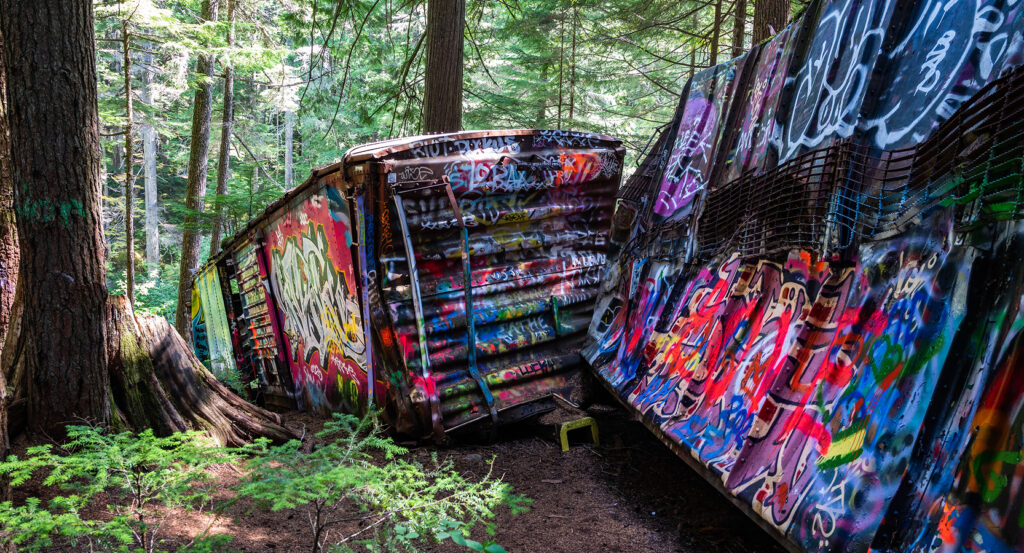
Hidden among towering cedars and moss-draped firs, this surreal site is a collection of seven derailed boxcars scattered across the forest floor, each one transformed into a riot of color by generations of graffiti artists. The first glimpse stops you cold: bright blues, neon oranges, and electric pinks splashed against the deep green of the forest, urban creativity meeting raw nature in perfect balance. The air hums with quiet, birdsong, wind through the trees, and the steady rush of the Cheakamus River below. To reach the wreck, you cross a suspended footbridge that sways above the turquoise water, the kind that both quickens your pulse and sharpens your senses. Once inside the forest, the trail feels almost enchanted. Sunlight filters through the canopy, illuminating bursts of paint on the train cars like stained glass. Some boxcars lean at strange angles, others rest upright, their walls now canvases for street artists who return year after year to refresh the murals. Each car tells a story, of collision, of decay, of renewal, and together they form a living gallery unlike anywhere else in the Pacific Northwest.
What you should know about Whistler Train Wreck.
Whistler Train Wreck began not as an attraction, but as an accident.
In 1956, a freight train loaded with lumber derailed after speeding through a sharp turn south of Whistler. Rather than remove the wreckage, local loggers used heavy machinery to drag the boxcars off the tracks and deeper into the forest, where they were left to rust in silence. For decades, the site remained a local secret, known only to adventurers and a handful of artists who hiked in to paint the steel shells with bold, rebellious color. Over time, the wreck evolved from forgotten debris into an open-air art exhibit, one that changed with every brushstroke and spray can. The blend of decay and vibrancy mirrors Whistler's own story, a town that thrives on the coexistence of rugged nature and creative energy. In 2016, a new suspension bridge was built to give hikers safe and legal access across the Cheakamus River, connecting the Train Wreck Trail to the Sea to Sky Trail system. Today, the boxcars are protected as part of Whistler's cultural heritage, with artists encouraged to paint but preserve the integrity of the site. Few realize that the area surrounding the wreck is also home to ancient cedar groves, some trees more than 700 years old, adding a layer of reverence to the experience. What was once an accident has become a masterpiece of transformation: an ode to human imperfection embraced by nature's quiet forgiveness.
How to fold Whistler Train Wreck into your trip.
Visiting Whistler Train Wreck is less about checking a box and more about stepping into a story that keeps evolving.
The trailhead begins just off Cheakamus Lake Road, a short drive from Whistler Village, and the hike itself is an easy, scenic 2 kilometers each way, perfect for a morning or afternoon adventure. Cross the famous suspension bridge first; it's the kind of moment that feels cinematic, with the turquoise river swirling below and the hum of the forest wrapping around you. Once you reach the wreck, take time to explore each car. Look closely at the artwork, the layers of paint, the textures of rust, the small messages scrawled across the steel. You'll notice themes of freedom, rebellion, and renewal repeated again and again. For photographers, the site is a dream, every angle reveals a new blend of light and color, metal and moss. Visit early in the day for solitude or closer to sunset when the forest glows amber and the artwork seems to come alive. After the hike, refuel with a craft beer or wood-fired pizza at Function Junction, a creative district nearby filled with local breweries, bakeries, and bike shops. Whistler Train Wreck isn't just a hike, it's an encounter with contrast. It's proof that beauty doesn't always come from perfection, sometimes, it's born from chaos, reclaimed by nature, and painted into something unforgettable.
Where your story begins.
Foresyte Travel reveals places that feel extraordinary long before you arrive.
Experience premium editorial crafted for luxury travelers.