Why Science World Globe matters.
The Science World Globe isn't just one of Vancouver's most recognizable landmarks, it's a symbol of curiosity itself, rising like a shimmering orb where False Creek meets the skyline.
Day or night, it commands attention. In daylight, its lattice of steel triangles gleams against the blue of the inlet; after sunset, thousands of LED lights pulse across its surface, rippling in patterns that make the city feel alive with imagination. Originally built as the Expo Centre for Expo '86, the geodesic dome was envisioned as a futuristic beacon, a promise that science and innovation could unite beauty and purpose. Today, it remains one of the city's most beloved cultural spaces, housing the Telus World of Science, and its reflective shell continues to mirror Vancouver's greatest duality: nature and progress in perfect balance. Beneath the globe's metallic skin, the energy shifts, a living, breathing environment where the chatter of children, the hum of exhibits, and the quiet awe of discovery blend into one symphony. To stand beneath it is to feel that you're touching the pulse of Vancouver's intellect, a city not afraid to wonder.
What defines Science World Globe.
The origin of the Science World Globe is rooted in Vancouver's moment on the global stage, the 1986 World Exposition on Transportation and Communication (Expo '86).
Designed by architect Bruno Freschi, the dome was constructed in less than six months, a feat of precision engineering that echoed Buckminster Fuller's vision for sustainable, modular architecture. The structure is made up of 766 aluminum triangles, each forming part of a geodesic sphere supported by an intricate steel skeleton. Its design wasn't just aesthetic, it represented a statement of global unity, symbolizing the interconnectedness of science and humanity. After the exposition, the city debated whether to dismantle the dome, but a growing movement of educators and citizens lobbied to transform it into a permanent science center. In 1989, Science World British Columbia officially opened its doors. The dome's innovative form allows for natural light to flood the interior while maintaining incredible energy efficiency, and its interior design was engineered to accommodate exhibits, theaters, and large-scale demonstrations. Over the years, it's become a testing ground for science communication, home to live experiments, IMAX presentations, and rotating exhibitions that explore everything from quantum physics to ocean ecology. In 2012, the exterior lighting system was completely modernized with thousands of programmable LEDs, allowing for real-time visual storytelling, the dome itself became a digital art form, pulsing with color for holidays, concerts, and even scientific data visualizations. Few realize that the entire structure rests on what was once an industrial wasteland of sawmills and docks, transformed through urban renewal into one of the most visited science museums in Canada. The Globe stands today as the ultimate legacy of Expo '86, not a relic of the future, but a living, evolving one.
How Science World Globe fits.
To experience the Science World Globe in its full brilliance, time your visit for both daylight exploration and nighttime illumination.
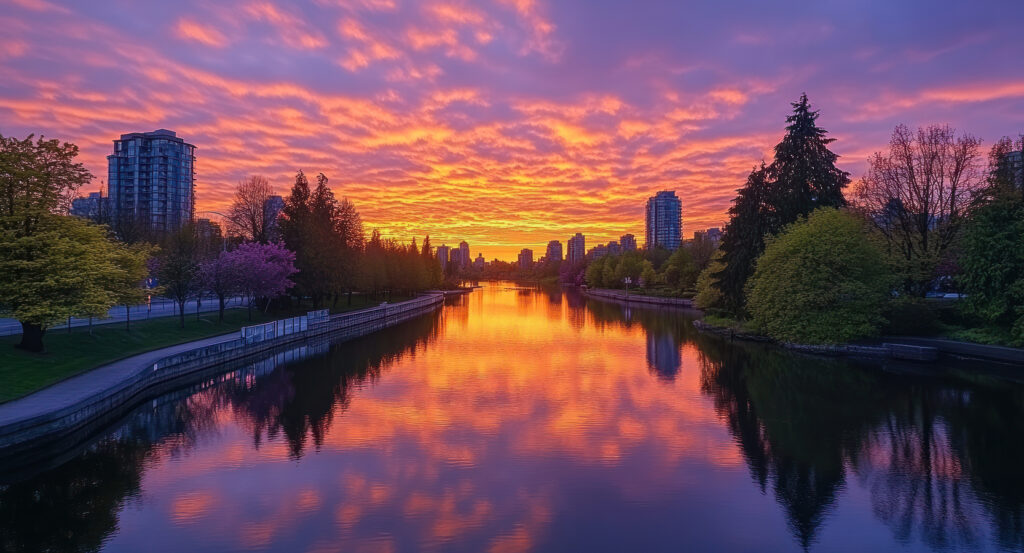
Arrive via the False Creek Seawall, approaching from Olympic Village or Yaletown, and let the dome reveal itself slowly, a futuristic form rising above the water with the mountains behind. Begin your visit inside Telus World of Science, where you can explore the Wonder Gallery, Ken Spencer Science Park, and the immersive OMNIMAX Theatre, each offering interactive ways to connect with the science that powers our world. Allocate two to three hours inside to truly experience its hands-on exhibits, then step back outside near sunset as the city's lights begin to shimmer across the bay. The real magic begins when the LEDs ignite, the dome glows like a digital lantern, its surface reflecting both the skyline and the stars. Walk the seawall loop to capture every angle: from Olympic Village, the reflection doubles in the water; from False Creek Ferries, you see it hovering above its own mirror image. If possible, take the Aquabus after dark and watch the lights ripple across the water, a living constellation above the city's heart. For photographers, the golden hour and blue hour are pure alchemy; for travelers, it's a reminder that innovation can be beautiful. The Science World Globe isn't just a building, it's a monument to human curiosity, a beacon that reminds every passerby to look up, ask why, and never stop wondering.
Where your story begins.
Foresyte Travel reveals places that feel extraordinary long before you arrive.
Enjoy editorial crafted for luxury travelers.
Foresyte may earn a commission when you book.