Why Harbour Town Golf Links matters.
Harbour Town Golf Links is a strategic championship course where Sea Pines' maritime Lowcountry character meets Pete Dye's exacting architecture, Jack Nicklaus' formative design work and a finishing stretch opening dramatically onto Calibogue Sound.
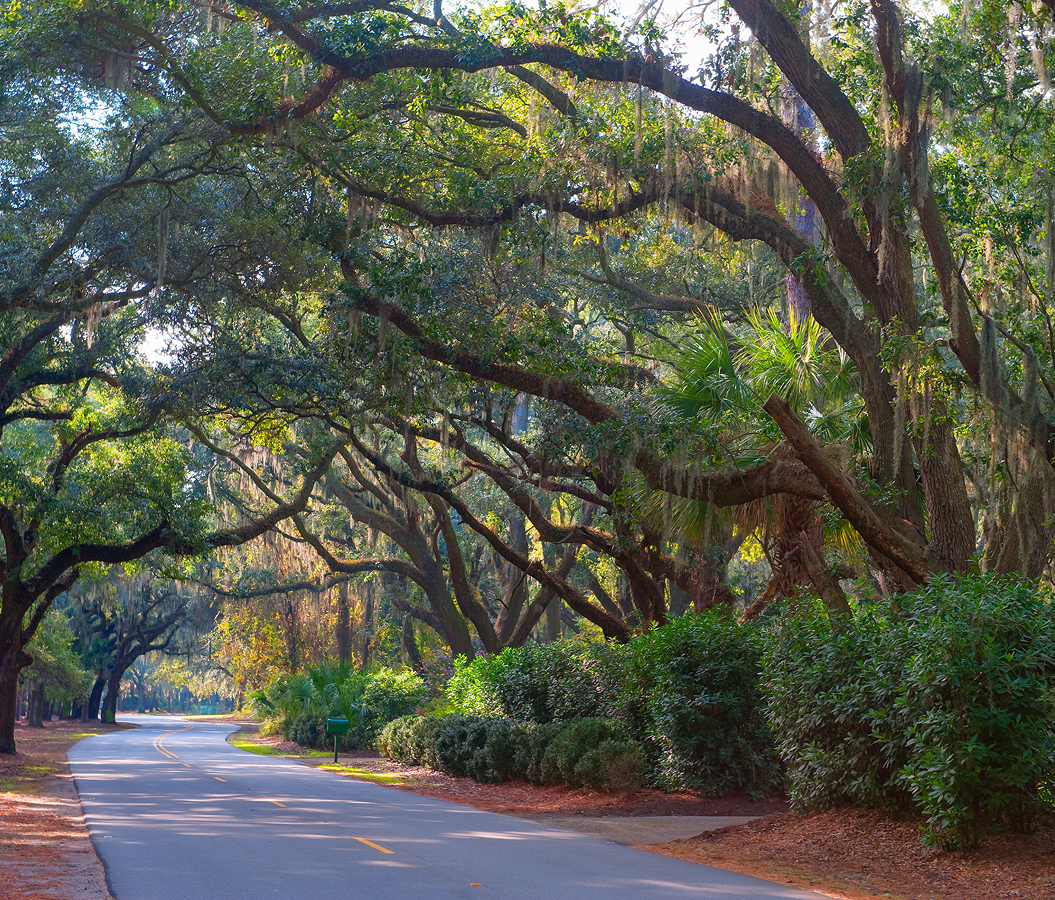
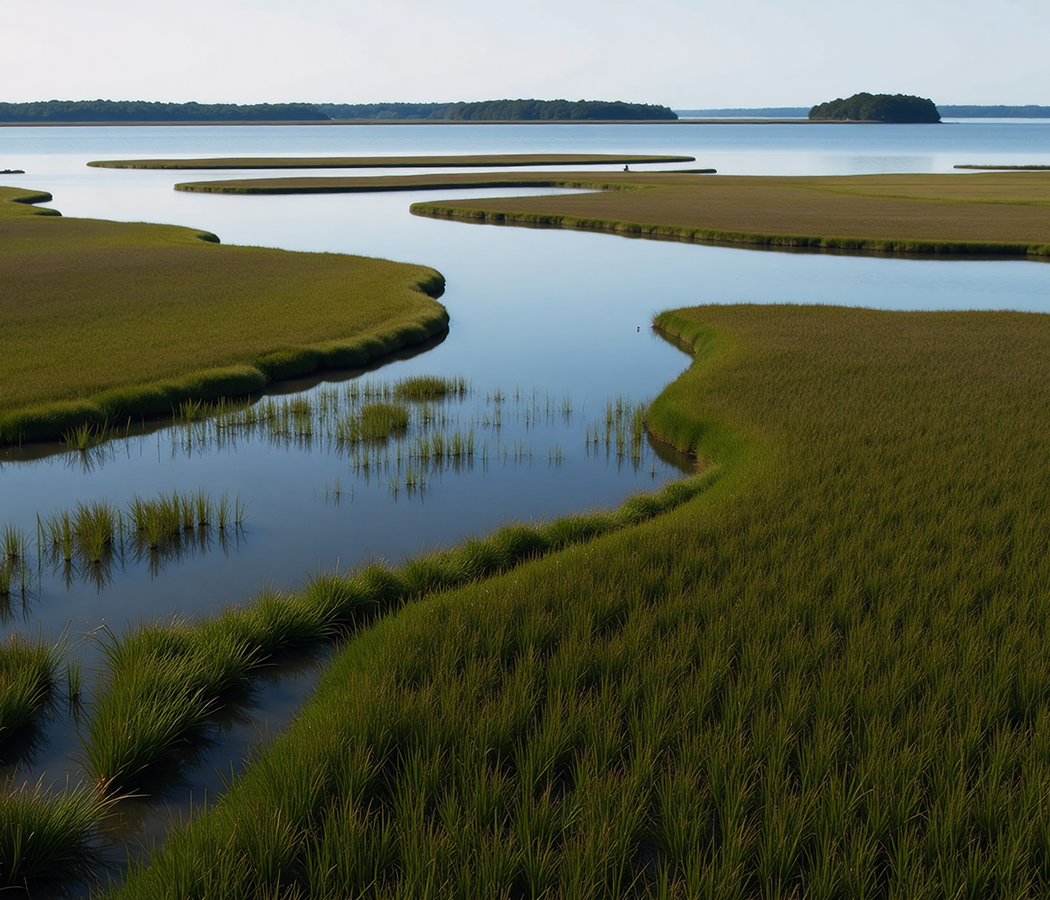
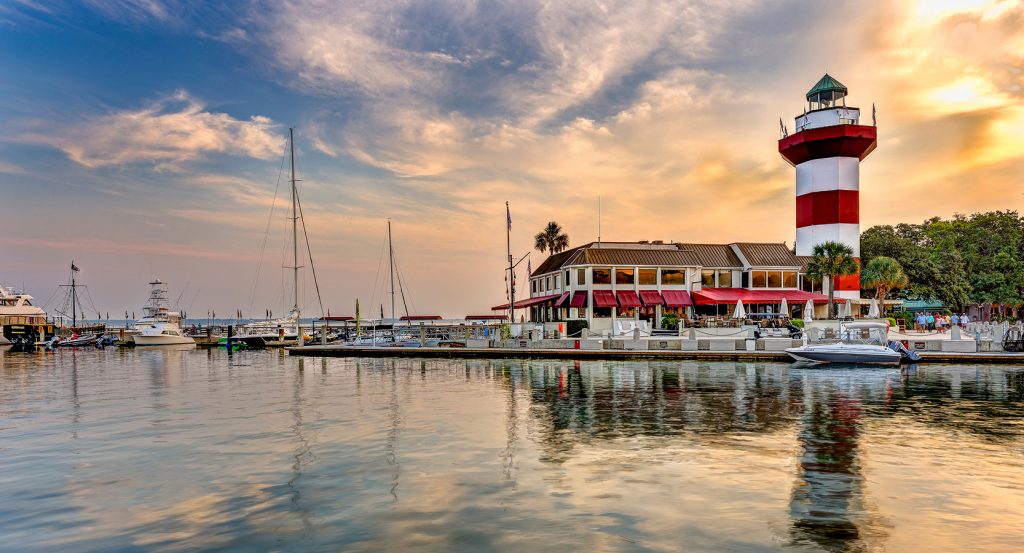
Set along Lighthouse Lane near Plantation Drive and just steps from Harbour Town Yacht Basin, the course occupies Sea Pines' southwestern shoreline between Calibogue Sound, maritime forest and residential enclaves extending inland across Hilton Head's southern end. Live oaks, pines and magnolias compress much of the routing into narrow corridors before the final holes emerge beside tidal water and open coastal sky. Small greens sit behind bunkers, overhanging limbs and angled hazards, making the preferred approach line visible from one portion of a fairway and obstructed from another. The eighteenth fairway breaks free of the forest beside Calibogue Sound, with Harbour Town Lighthouse rising beyond the green as the course reaches its broadest coastal exposure. The result is a tightly controlled golf landscape whose wooded corridors, compact targets and waterfront finish make precision inseparable from the Lowcountry terrain.
What defines Harbour Town Golf Links.
Harbour Town Golf Links is best known for Pete Dye, Alice Dye and Jack Nicklaus creating a 1969 course that challenged the prevailing emphasis on length through narrow landing areas, small greens, strategic angles and trees deliberately retained as obstacles. Sea Pines founder Charles Fraser wanted a championship course with an old-fashioned character and initially approached Nicklaus, then twenty-eight and already a seven-time major champion, to attach a prominent competitive name to the project. Nicklaus recommended Pete Dye, an Ohio architect whose professional portfolio still contained fewer than ten courses, after the pair had collaborated at The Golf Club near Columbus. Dye and Nicklaus formally began the Harbour Town project on July 2, 1968, only three months before the PGA TOUR accepted Fraser's proposal for a tournament there during Thanksgiving week the following year. Alice Dye supplied consequential design input of her own, including the thirteenth hole, which she sketched on a napkin before directing the construction of its deep cypress-faced greenside bunker. The completed course crossed extraordinarily flat terrain with only several feet of elevation change, forcing architecture, vegetation and angles to generate strategic complexity across land offering little natural vertical relief. The inaugural Heritage Classic immediately demonstrated the severity of the design as thirty-nine rounds of 80 or higher appeared across the first two days. Arnold Palmer finished at one under par as the sole player below par for the week, ending a fourteen-month victory drought and giving Fraser's new tournament an internationally recognized champion at its debut. Nicklaus won on the course he helped design in 1975, and later champions included Johnny Miller, Tom Watson, Greg Norman, Payne Stewart, Davis Love III, Jordan Spieth and Scottie Scheffler. Dye credited Harbour Town with launching his architectural career before later projects such as TPC Sawgrass, Whistling Straits and the Ocean Course at Kiawah Island expanded his influence across modern golf design. The Sea Pines Resort completed a major restoration in 2025 with five-time Heritage champion Davis Love III and Love Golf Design serving as player consultant, preserving the course's established shot values through the work. Harbour Town reopened in November 2025 and continues as the annual site of the RBC Heritage, whose 2026 edition drew 120,000 spectators and extended a tournament lineage uninterrupted at the course since 1969.
Angles determine the course's difficulty by making the destination of one shot dependent on where the preceding shot finishes. Narrow fairways initially appear to reward simple accuracy, yet trees extending into playing corridors divide those landing areas into substantially different approach positions. A drive finishing on the unfavorable side leaves trunks, limbs or bunker geometry between the ball and a compact green, forcing trajectory and curvature into the next decision. Placement on the preferred side opens a cleaner visual corridor and permits the approach to use the green's available depth. Small putting surfaces intensify that relationship by reducing the area capable of receiving an imperfect approach, so positional errors accumulate across consecutive strokes. Dye used bunkers, cypress planking and abrupt edges to sharpen those targets further, with Alice Dye's thirteenth presenting a green fronted by a deep timber-faced hazard that strongly rewards entry from the proper fairway angle. Wind assumes greater influence once the routing reaches Calibogue Sound, where the wooded containment of earlier holes gives way to exposed coastal air. The par-three seventeenth demands a carry toward a green beside the sound before the eighteenth turns the shoreline itself into the dominant strategic boundary. Its broad visual field contrasts with the constricted forest corridors behind it, yet the exposed water and coastal wind continue demanding control as the player advances toward the lighthouse. Harbour Town Golf Links builds its challenge through this chain of positional consequences, making tee placement determine approach geometry, approach geometry determine usable green area and the coastal finish test those accumulated demands under open wind.
How Harbour Town Golf Links fits.
Harbour Town Golf Links works as the sporting anchor for a Sea Pines route connecting Charles Fraser's striped harbor beacon, archaeological remnants of a nineteenth-century plantation and a protected forest containing evidence of human occupation extending thousands of years into Hilton Head's past.
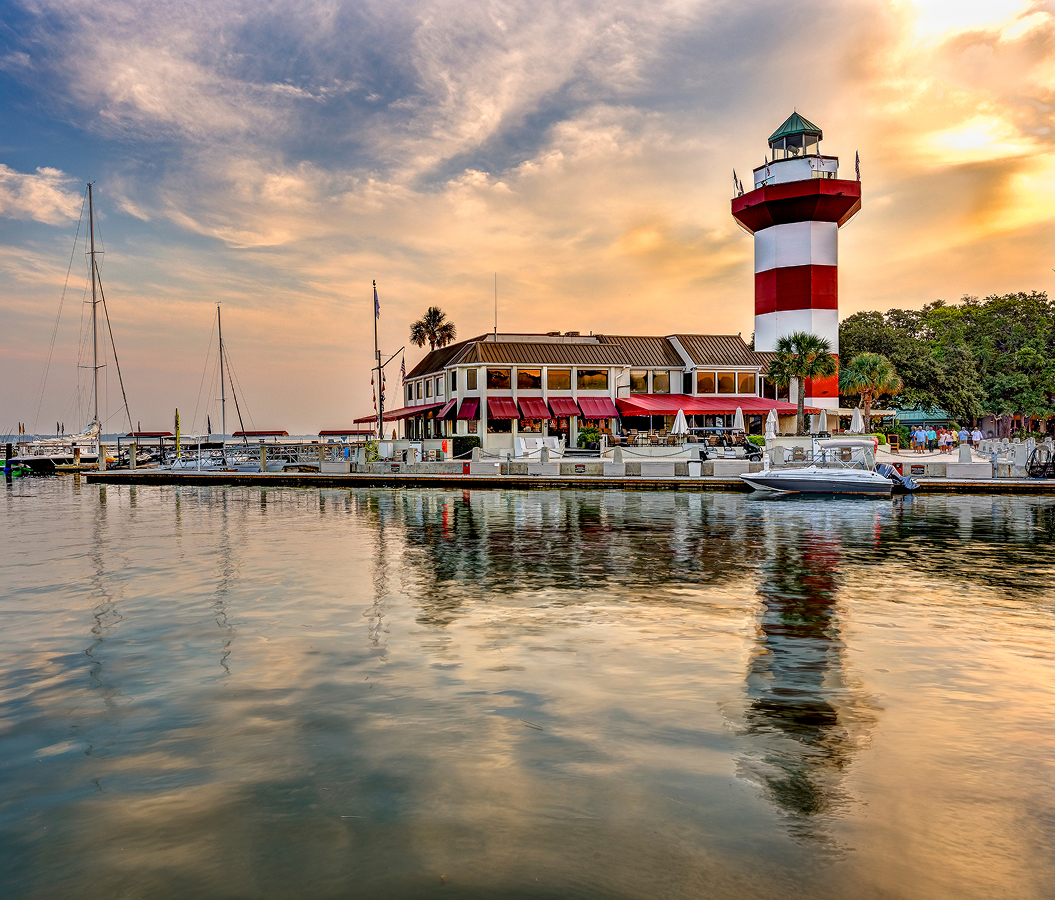
Begin at Harbour Town Lighthouse, conceived by Sea Pines founder Charles Fraser as the visual centerpiece of the yacht basin he was developing beside Calibogue Sound. Construction of the ninety-foot red-and-white-striped tower began in 1968, though work was unfinished when the first Heritage Classic brought professional golf to Sea Pines the following year. Fraser intended the structure to draw people toward Harbour Town, and its position beside the marina eventually made the tower inseparable from televised views across Harbour Town Golf Links' eighteenth hole. The interior ascent covers 114 steps and incorporates exhibits spanning island history, the Civil War and the Heritage tournament before reaching an observation level above the harbor. Continue to Stoney Baynard Ruins, where tabby remnants preserve the footprint of a property once known as Braddock's Point. William Baynard acquired part of the property in 1845, and Union forces later occupied the site as headquarters during the Civil War. The Baynard family recovered the property after the conflict, but the house burned in 1869 and was never reconstructed. Surviving portions include the main residence, a chimney footing associated with another structure and the foundation of a dwelling used by enslaved people, preserving physical evidence of the island's plantation-era history inside modern Sea Pines. Conclude at Sea Pines Forest Preserve, a protected tract containing wetlands, maritime forest, wildlife habitat and archaeological evidence reaching far deeper into Hilton Head's human history. A shell ring inside the preserve dates to Indigenous activity more than 4,000 years ago, when people used the island for hunting and harvesting coastal resources. The circular accumulation survives as one of the preserve's most consequential archaeological features, connecting the modern resort landscape with communities occupying the coast millennia before European settlement. Boardwalks and trails extend through freshwater wetlands and forest, placing that archaeological site within the ecological systems that sustained human activity across the island. The progression moves from Fraser's purpose-built symbol of modern Sea Pines through the surviving remains of Braddock's Point and culminates inside protected maritime forest where a shell ring pushes Hilton Head's human chronology back more than four millennia.
Where your story begins.
Foresyte Travel reveals places that feel extraordinary long before you arrive.
Enjoy editorial crafted for luxury travelers.
Foresyte may earn a commission when you book.