Why you should experience Place de la Concorde in Paris, France.
To stand in Place de la Concorde is to feel Paris at its most theatrical, a stage where centuries of triumph and tragedy have unfolded under an open sky.
It's a plaza of paradoxes, both regal and revolutionary, framed by fountains, marble statues, and the steady hum of modern life. The Egyptian obelisk at its center, a 3,000-year-old gift from Luxor, rises like a golden needle through the city's rhythm, connecting ancient civilizations to the beating heart of modern France. Around it, the symmetrical perfection of the square, envisioned by Ange-Jacques Gabriel, mirrors the city's obsession with beauty and order. Yet beneath its serene geometry lies the shadow of history: this was once the site of the guillotine, where Louis XVI and Marie Antoinette met their fate during the Revolution. To visit Place de la Concorde is to confront the layered soul of Paris, its capacity for both splendor and upheaval, grace and defiance, all contained within one breathtaking expanse.
What you should know about Place de la Concorde.
What most visitors don't realize is that Place de la Concorde was once an audacious experiment, a reimagining of urban space long before such ideas had a name.
It was designed not merely as a square, but as a declaration: that power, architecture, and the people could coexist in visual harmony. The two grand façades along the north side, modeled after the Louvre, were early prototypes for the city's neoclassical aesthetic. During the Revolution, this harmony fractured, the square became a theater of justice and horror, renamed Place de la Révolution. Yet even in its bloodiest moments, it represented transformation. Today, that duality still resonates. The obelisk, once a symbol of divine rule, now stands as a secular monument, its gold-leafed tip catching the same sunlight that glitters off the Seine. Few places embody the Parisian paradox more elegantly: ancient yet ever-evolving, somber yet stunning.
How to fold Place de la Concorde into your trip.
To fold Place de la Concorde into your Paris itinerary, approach it as both a crossroads and a meditation.
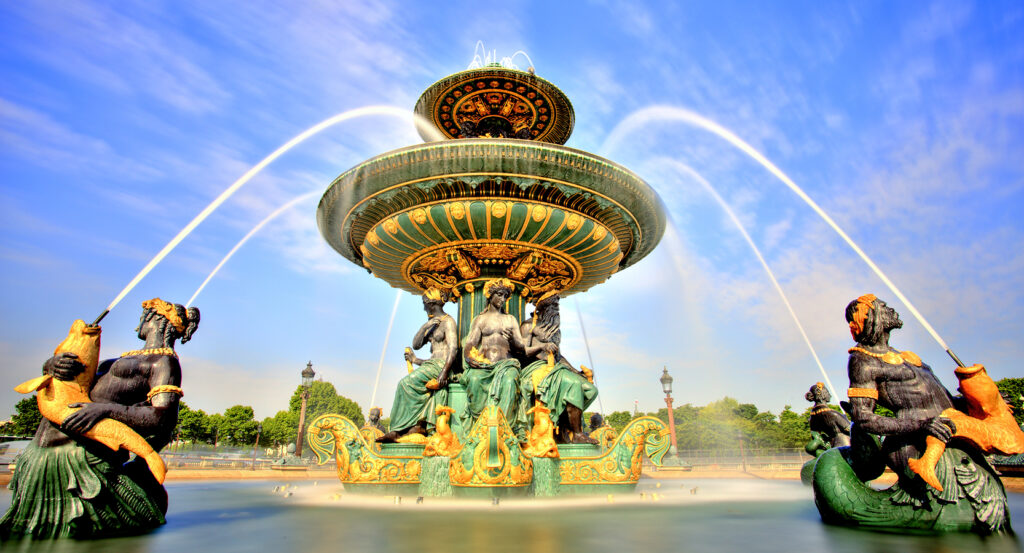
Arrive from the Tuileries Garden at sunset, when the fountains shimmer and the traffic's pulse begins to slow. Take in the 360-degree panorama, the Champs-Élysées stretching west toward the Arc de Triomphe, the golden dome of Hôtel des Invalides gleaming to the south, and the Madeleine Church rising to the north like a Greco-Roman temple. From here, Paris feels almost cinematic, each axis leading to a different era of its story. Linger by the fountains designed by Jacques Ignace Hittorff, whose maritime motifs celebrate France's global influence, then cross the square to glimpse the bridge of Pont de la Concorde, itself built from stones salvaged from the Bastille. When you leave, do so slowly. Few spaces in the world invite you to witness the dialogue between beauty and history with such poise.
Where your story begins.
Start the planning journey with Foresyte Travel.
Experience immersive stories crafted for luxury travelers.