
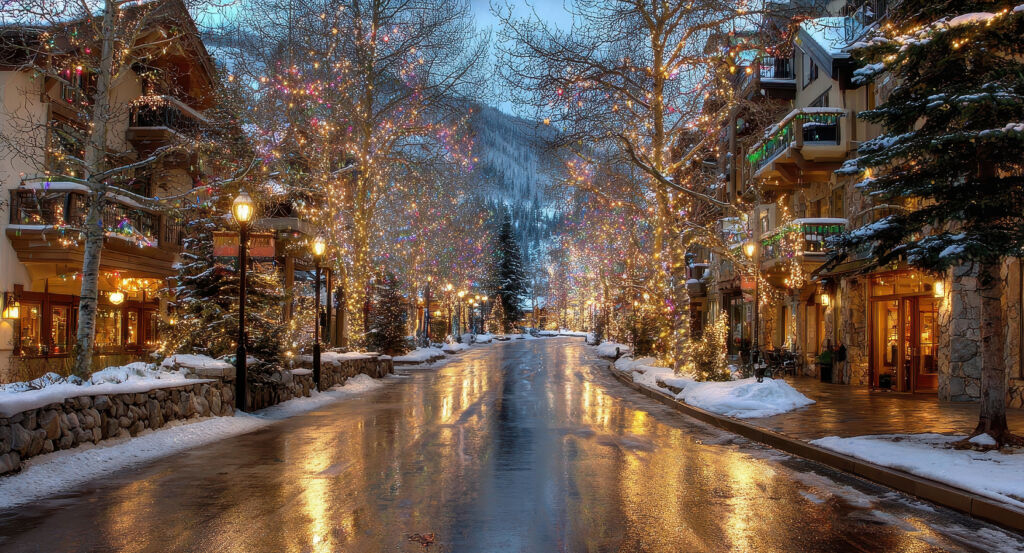
Why Vail Ski Resort matters.
Vail Ski Resort is a high-altitude alpine skiing complex where the Gore Valley's mountain terrain meets the military skiing heritage of the 10th Mountain Division, the vast open slopes of Colorado's Back Bowls and the resort development ambitions that reshaped American winter recreation.
Rising above Vail Village between Golden Peak and Lionshead, the ski area occupies the northern slopes and southern basins of Vail Mountain within the White River National Forest, extending from the Gore Creek valley floor toward the high ridgelines overlooking the Sawatch and Gore ranges. Forested trails descend toward the resort's three principal base areas, connecting mountain recreation with pedestrian commercial districts. Open alpine bowls extend across the mountain's southern slopes, where broad terrain and exposed ridgelines create a distinct skiing environment. A network of gondolas, chairlifts and mountain facilities connects the wooded frontside with the extensive terrain beyond the summit. The result is a mountain resort whose exceptional geographical scale, varied alpine terrain and direct relationship with its purpose-built base communities have influenced American skiing for more than six decades.
What defines Vail Ski Resort.
Vail Ski Resort is best known for its 5,317 acres of skiable terrain, seven interconnected Back Bowls and founding by Pete Seibert and Earl Eaton, whose development established one of the largest single-mountain ski areas in North America. The surrounding Gore Valley formed part of the ancestral territory of the Ute people, who traveled through the Central Rocky Mountains for hunting, seasonal settlement and access to mountain resources. Nineteenth-century mining activity brought European American settlement into the surrounding ranges, followed by ranching and transportation development along the valley floor. Construction of U.S. Highway 6 during the late 1930s improved access through the mountains, with the highway and nearby pass named for state engineer Charles Vail. During World War II, Seibert trained with the United States Army's 10th Mountain Division at Camp Hale before serving in Italy, where he sustained serious combat injuries. His military training introduced him to specialized mountain travel and the technical demands of skiing across difficult terrain. Eaton, an experienced Colorado mountaineer and prospector, recognized the recreational potential of the mountain's extensive southern basins. On March 19, 1957, the two men climbed the mountain from Mill Creek Road, traversing wooded slopes before reaching a ridge overlooking the broad terrain that became central to their plans. Their subsequent partnership attracted investors and led to the organization of Vail Associates in 1959. Construction began in spring 1962, requiring federal authorization, lift installation, trail cutting and the creation of infrastructure in a sparsely populated valley. The resort opened on December 15, 1962, with a gondola, two chairlifts and lift tickets priced at five dollars. The introduction of additional lifts and terrain during the following decades established a substantial recreational network across the mountain. Vail hosted the Alpine World Ski Championships in 1989 and shared hosting responsibilities with Beaver Creek in 1999 and 2015, connecting the resort with international competitive skiing. The 1997 combination of Vail Associates with the owners of Breckenridge and Keystone created Vail Resorts, establishing the corporate structure that subsequently expanded into a major international mountain operator. Continued lift modernization and terrain development preserved the mountain's position within Colorado's skiing industry.
Blue Sky Basin occupies the southeastern portion of the ski area, combining gladed slopes, open meadows and wooded ridgelines in a setting resembling the surrounding backcountry. Its terrain opened to the public in 2000, extending lift-served skiing into a substantial area beyond the established bowls. The seven Back Bowls encompass 2,785 acres, with terrain distributed across Sun Down, Sun Up, Tea Cup, China, Siberia, Inner Mongolia and Outer Mongolia bowls. Sun Down Bowl contains steep gullies, wooded passages and exposed slopes, including Windows and Never, whose entrances require careful route selection. Sun Up Bowl incorporates the broad terrain of the Slot and Après Vous, connecting elevated ridgelines with lower wooded sections. Tea Cup Bowl occupies a smaller basin between neighboring areas, with trails named in association with the Celestial Seasonings tea company. China Bowl contains the groomed Poppyfields runs, providing intermediate access to expansive open terrain. Genghis Khan occupies a steeper section of the same basin, with a cornice and sustained pitch suited to advanced skiing. Siberia Bowl contains the challenging Rasputin's Revenge, where cliffs, couloirs and exposed faces demand technical ability. Inner and Outer Mongolia bowls occupy the eastern extremity of the interconnected terrain, with open glades and broad powder slopes reached through an extended traverse. Game Creek Bowl occupies a separate western basin, incorporating groomed runs, moguls and changing slope orientations. Riva Ridge descends four miles from the upper mountain, connecting sustained vertical skiing with the wooded frontside. The ski area reaches an elevation of 11,570 feet, with its principal base at 8,120 feet. Thirty-two lifts serve 278 trails, providing access to terrain classified across beginner, intermediate and advanced categories. Average annual snowfall reaches 354 inches, supporting a winter season shaped by frequent mountain storms and substantial variations in snow conditions. The distribution of terrain across wooded slopes, open basins and high ridgelines allows skiers to select routes according to ability, snow conditions and changing weather.
How Vail Ski Resort fits.
Vail Ski Resort works as the mountain recreation centerpiece for a Vail itinerary connecting Colorado's military skiing history, the conservation of high-elevation botanical environments and the performing arts institutions that established the Gore Valley as a year-round cultural destination.
Begin at Colorado Snowsports Museum, situated beside Vail Village's principal parking structure near South Frontage Road. The institution preserves skis, snowboards, uniforms, photographs and equipment associated with the development of winter sports throughout Colorado. Its exhibitions examine the 10th Mountain Division, whose soldiers trained in the Rocky Mountains before undertaking combat operations in Italy during World War II. Historical equipment and military artifacts connect specialized mountain training with the subsequent development of American recreational skiing. The Colorado Snowsports Hall of Fame recognizes athletes, instructors, equipment designers and industry figures whose achievements shaped the state's winter sports institutions. Continue to Betty Ford Alpine Gardens, situated within Ford Park east of the village center. Founded in 1985 and named for former First Lady Betty Ford, the gardens cultivate alpine plants from mountainous environments across the world. Their botanical collections demonstrate adaptations to short growing seasons, intense sunlight and challenging mountain soils. Rock gardens, waterfalls and carefully arranged planting beds provide access to species associated with different elevations and geographical regions. Educational programs examine alpine ecology, plant conservation and the environmental pressures affecting fragile high-elevation habitats. Conclude at Gerald R. Ford Amphitheater, the outdoor performing arts venue situated beside the gardens in Ford Park. Opened in 1987 and named for President Gerald Ford, the amphitheater became an important center for Vail's summer cultural programming. Its covered stage, terraced seating and landscaped lawn accommodate orchestral performances, dance productions and community events against a mountain backdrop. The venue hosts performances associated with Bravo! Vail and the Vail Dance Festival, connecting the mountain community with internationally recognized musicians and dance companies. The progression moves from Colorado's skiing heritage through the conservation of alpine plant life and culminates in the performing arts institutions that expanded Vail's cultural significance beyond winter recreation.
Where your story begins.
Foresyte Travel reveals places that feel extraordinary long before you arrive.
Enjoy editorial crafted for luxury travelers.
Foresyte may earn a commission when you book.


























































































































